
SUCCESS STORIES
Navigating the Payments Technology Landscape with Expertise
Discover how we've helped our clients.
Check back soon
Once case studies are published, you’ll see them here.

Case Study
How We Built the Right Payment Processor Combination for a Foreign-Owned, Multi-Entity Merchant
11 December 2025
Challenge
This merchant sits squarely in high-risk territory — a multi-entity, cross-border structure that draws elevated scrutiny from any processor by default. When they first came to us, they were running through two developer-friendly, self-serve payment platforms — the kind built for fast integration rather than an ongoing relationship. One handled general processing; the other specialized in cross-border payment methods for international customers. Both were easy to set up, but neither came with real underwriting or risk review upfront, and there was no dedicated point of contact at either organization to manage commercials, product changes, support issues, or risk reviews as the business grew. At the time, the merchant was processing entirely through its U.S.-based entities — its foreign entity hadn't yet been engaged for U.S. processing. That left the business exposed on two fronts at once: no real relationship behind either processor, and no fallback if either one's risk appetite changed.
Approach
We built a deliberate combination of processor relationships rather than relying on self-serve setups with no real backing:
Category Mapping: Evaluated the merchant's risk profile and settlement needs against distinct processor categories — a best-priced acquirer, an industry specialist, global cross-border infrastructure, a PSP aggregator with stablecoin-native settlement, a Merchant of Record, and high-risk ISO access.
Engaging the Foreign Entity: Brought the merchant's foreign entity into the U.S. processing stack through two channels — a Merchant of Record relationship, and a global acquirer's European cross-border acquiring option that gave the foreign entity its own MID. The cross-border fees on that volume are modest compared to the ongoing cost of standing up and maintaining a separate U.S. entity — a cost this structure avoids entirely.
Deliberate Onboarding: Each relationship was onboarded for a specific role in the stack, with a real point of contact for commercials, product, support, and risk — not a support queue.
Built-In Exit Paths: Negotiated termination-for-convenience clauses into every relationship, so the merchant could test and walk away from anything that didn't hold up.
Results
The merchant ended up with more than redundancy — real relationships and real flexibility:
A Real Point of Contact, Not a Queue: Every processor relationship comes with someone accountable for commercials, product, support, and risk.
Protection Against Risk-Appetite Changes: No longer dependent on a single processor's underwriting decisions.
Routing Flexibility: Able to route transactions through the entity — foreign or U.S. — best suited to each relationship.
A U.S. Entity, Without a U.S. Entity: The foreign entity's own MID and cross-border acquiring relationship accomplish what a new U.S. entity would have — at a fraction of the cost of setting one up and maintaining it.
The plan from day one was to test the full combination and settle on the two or three relationships that earned a permanent place in the stack. Most foreign-owned merchants default to developer-friendly, self-serve platforms because they can get set up fast — without a human element in the process, and without the language barriers that come with it. That speed comes at a cost: no real underwriting upfront, and no one to call when a reserve, a policy change, or a support issue actually needs a person. GPC bridges that gap directly — we work through the language and communication barriers, and get merchants set up from day one with real relationships built around the right risk profile, rather than whichever platform presented the lowest barrier to entry.

Case Study
How We Got a Rolling Reserve Removed for a Foreign-Owned Merchant
3 March 2026
Challenge
A foreign-owned merchant came to us with a rolling reserve that was eating into their working capital. The business established a new MID that was healthy and growing, but didn't have prior processing history so the payments processor implemented a reserve. A portion of every sale was being withheld by their processor as a risk buffer — leaving less cash on hand than the business's actual performance justified.
Approach
Global Payments Consultants (GPC) built the case for removal with evidence rather than argument:
Documented Track Record: Compiled processing statements, bank statements, and tax returns from a sister company under common ownership and management, showing a clean, consistent history over time.
Direct Presentation to the Payment Processor: Presented that documented history directly to the processor rather than negotiating the point in the abstract.
Cross-Corporate Guaranty (Backup Plan): Prepared a cross-corporate guaranty as a fallback in case the processor needed assurance beyond the financials.
Results
The documented track record proved compelling enough on its own — the guaranty was never needed:
Reserve Fully Removed: The rolling reserve was eliminated entirely.
Cash Flow Restored: Funds that had been tied up as a risk buffer returned to the merchant's own hands.
Risk Reassessed with Evidence: The payment processor moved on data, not negotiation alone.
Most foreign-owned merchants assume a rolling reserve is simply a cost of doing business in the U.S. It isn't always — reserves are frequently negotiable, and the outcome usually comes down to whether you can show a payment processor a documented, consistent history.

Approach
Building a Support Process That Prevents Disputes Before They Happen
15 July 2026
Challenge
Rising disputes often trace back not to fraud, but to gaps in customer support — tickets that go unresolved, inconsistent handling, or a support process that was never actually built around the reasons customers dispute charges in the first place. Most merchants build support reactively, one policy or FAQ at a time, without ever mapping it against the disputes it's supposed to prevent.
Approach
GPC audits and rebuilds the support process around the disputes it's meant to prevent, not around assumptions about what support should look like:
Full Ticket Audit: Reviews every support ticket a business has handled — including edge cases and lower-frequency issues, not just the most common categories.
Anticipated Ticket Mapping: Identifies likely future ticket types based on the product, billing model, and dispute patterns, before they turn into complaints.
SOP Built From Real Data: Builds the support process and FAQ content directly from documented ticket and reason-code data, rather than generic best practices.
Component-by-Component SLA Testing: Tests every part of the support process against its own SLA to confirm it holds up under real conditions, not just on paper.
Results
This approach is designed to catch the friction that turns into disputes before it reaches a chargeback:
Fewer Preventable Disputes: Customers get resolution through support instead of filing a dispute with their bank.
Lower Support Ticket Volume: Policies — returns, refunds, and other common questions — are configured to be easy for customers to find, paired with a well-designed FAQ that resolves concerns before they ever become a ticket.
SLA Accountability: Every support component is tested against its committed response and resolution times, not assumed to be working.
A Living Process, Not a One-Time Fix: The SOP is built to be revisited as ticket patterns shift, rather than set once and left alone.
The combined effect compounds: fewer disputes and fewer tickets both reduce the support team's day-to-day exposure, which shows up directly as lower support costs. This is the kind of work that rarely gets attention until disputes are already a problem. It's one of the most overlooked levers a business has for cutting chargebacks and support costs at the same time — and it's a core part of how we work with clients today.
Case Study
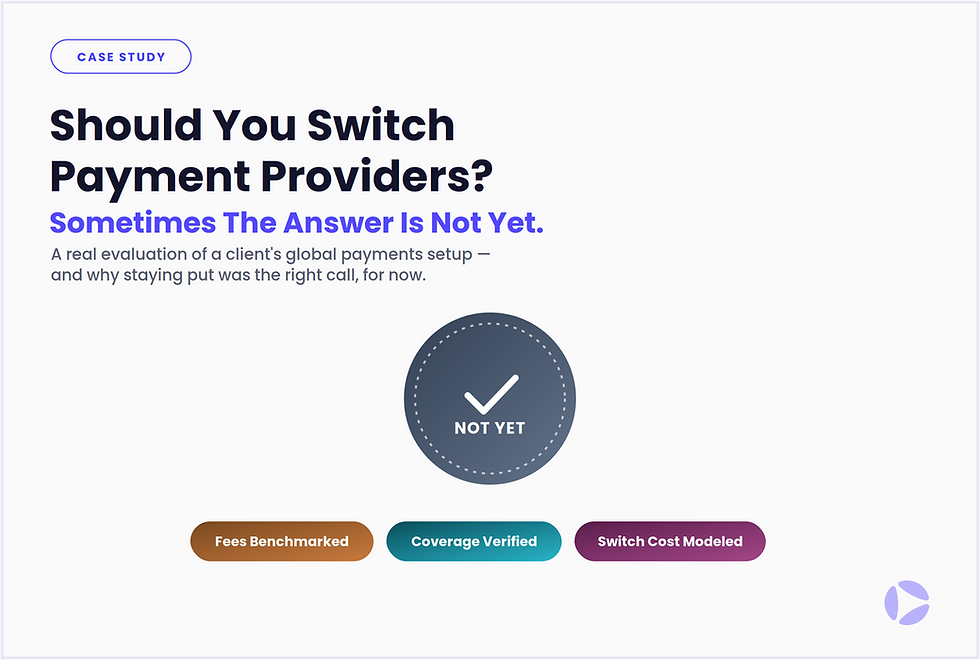
How We Told a Client Not to Switch Payment Providers — Yet
21 November 2024
Challenge
An IT services and consulting firm paying contractors across a dozen-plus countries asked us to evaluate whether they should switch global payment providers as they scaled. They weren't reporting a broken setup — just an unreviewed one. Like many growing companies, they'd chosen a provider years earlier and never revisited whether it was still the right fit, leaving them without real evidence either way.
Approach
We evaluated the actual data before assuming a switch was the answer:
Full Fee and Coverage Audit: Reviewed real transaction data across every country and payment method, rather than relying on assumptions about pricing or coverage gaps.
Distinguishing Platform Gaps From Process Gaps: Investigated a country the client had flagged internally as "unsupported" and found the gap was a documentation issue on their end, not a platform limitation.
Modeling the Cost of Switching, Not Just the Savings: Weighed the fee differences against the real cost of migration — re-onboarding every contractor, redoing compliance documentation, and the risk to payment continuity during a transition.
Results
The evaluation gave the client a clear, evidence-based answer instead of a default recommendation to move:
Fees Benchmarked, Not Assumed: Identified specific payment methods running a few percentage points higher than ideal — real, but not enough on their own to justify a switch.
A Coverage Gap Resolved Without Switching: The "unsupported" country turned out to be fully covered; the fix was a documentation correction, not a new provider.
A Clear Trigger to Revisit: Flagged the provider's pending acquisition by another global payments company as the specific event that would prompt a fresh review as the deal moves toward close.
Staying put isn't the safe default — it's the answer that held up against migration cost, disruption risk, and real fee data. The goal of a payment provider evaluation isn't to find a reason to move; it's to know, with evidence, whether the current setup still fits, and to have a clear answer for what would change that.
"Our interactions were great, you have been a valued partner for myself and my team."

Filip Bruteanu
Sr. Royalty Analyst, Adobe
“Working with Nick was a great experience. He's a pro at managing relationships and making sure that client needs are met in a timely and satisfactory manner. We never felt like we were left out to dry with urgent needs as Nick was always there, ready and happy to assist.”

Jack Tyrrell
Senior Financial Operations Analyst, Catalant Technologies
